Apple is usually terrific at promoting new capabilities of new software and hardware offerings, but I stumbled across this one, that I had not even heard about, at the San Francisco Apple store last week. It's not an Apple product per se, but it is so cool, I'd have thought they might promote it.
Being from Vancouver, I love San Francisco, and need no more than a mention of a chance to go there for a quick trip. Last week's American Advertising Federation was my latest excuse. In for a couple nights at the small boutique Harbor Court Hotel and a wonderful dinner thanks to my colleague Mark from Adobe (thanks, Mark!) at the Ozumo experience (they don't even call it a restaurant!).
With a couple hours to kill, I walked down Market St. to O'Farrell and past the (sadly) now-closed FAO Schwartz to the newer toy store, at Apple. Wondering around the new macbooks, climbing the green glass stairs, perusing the racks, I saw what looked like a new Jam Pack, those collections of loops for making songs in GarageBand.
But no, this wasn't yet another collection of tubas, oboes, and funky world-drum beats. It was TrackPak, something I had only dreamed would be offered one day, but a dream come true for guitarists old enough to remember when Eric Clapton played with Cream.
TrackPak is a digital version of some of the Master Tracks of various themes. I bought the Classic Rock version with tracks like Sunshine of Your Love, Smoke on the Water, and Sweet Home Alabama. These are songs I spent hours with, my guitar on my lap and picking up the needle on records to pick out every note of the solos. They are slightly mixed down from the master tapes, but you can still solo out the lead and rhythm guitars, drums, and bass.
For musicians who want to hear the detail on these classic tracks, TrackPak is a great deal. It will also make a great addition to our GarageBand remixes, where we can now sample a snippet from a solo without having to pull in all the other tracks as well.
Thursday, June 15, 2006
Tuesday, June 06, 2006
Sub-ether Hotel Networking
A little known fact for mac users in hotels with wired internet access.
iTunes music sharing and iChat work even if you haven't paid for the internet access.
Sure, if you want to google something you need to pony up the $10 to get outside the firewall, but sitting here in the Chicago Westin for a conference, I have access to a bunch of excellent iTunes playlists to engage in that most esoteric of hotel-bound, stuck-in-your-room-doing-email, people-sports; what's in YOUR itunes list?
iTunes music sharing and iChat work even if you haven't paid for the internet access.
Sure, if you want to google something you need to pony up the $10 to get outside the firewall, but sitting here in the Chicago Westin for a conference, I have access to a bunch of excellent iTunes playlists to engage in that most esoteric of hotel-bound, stuck-in-your-room-doing-email, people-sports; what's in YOUR itunes list?
Saturday, June 03, 2006
Websites as graphics

The fact that website are hierarchical structures is obvious, but what isn't obvious is how beautiful a site can be when its representation is abstracted away from the html into the tagged structure itself. Such is the result from Websites as graphs. Above is a picture of this blog site. Sala has some fine examples. Now if I could just get the url for each node so I could decipher the back links...
Wednesday, May 17, 2006
Secrets of Harry Potter and the Deathly Hallows
Yes, it is true, I have seen the vision of the final book in the Potter series. I'll tell you about it if you promise not to say anything to anyone else...
1. Dumbledore is not dead. Snape and he set it up to allay suspicion. See North by Northwest by Alfred Hitchcock.
2. Snape is actually a good guy, who was redeemed from death-eater status by the the love he felt for Lily, before she became Harry's mother. Dumbledore knows this, and they have worked together to manage his appearance as a double-agent.
3. The fact that Harry has "his mother's eyes" is a reminder to Snape of his responsibility to protect him.
4. Voldemort is destroyed by the thing he never understood - love, sacrifice and friendship.
5. Harry will have to die to kill Voldemort, like Neo and Smith in The Matrix.
6. Hermione and Ron get married and have wild kids with curly red hair - ok, maybe not.
7. Petunia is committed to protecting Harry because Dumbledore has enabled it to protect him, and out of shame for how she treated Lily.
1. Dumbledore is not dead. Snape and he set it up to allay suspicion. See North by Northwest by Alfred Hitchcock.
2. Snape is actually a good guy, who was redeemed from death-eater status by the the love he felt for Lily, before she became Harry's mother. Dumbledore knows this, and they have worked together to manage his appearance as a double-agent.
3. The fact that Harry has "his mother's eyes" is a reminder to Snape of his responsibility to protect him.
4. Voldemort is destroyed by the thing he never understood - love, sacrifice and friendship.
5. Harry will have to die to kill Voldemort, like Neo and Smith in The Matrix.
6. Hermione and Ron get married and have wild kids with curly red hair - ok, maybe not.
7. Petunia is committed to protecting Harry because Dumbledore has enabled it to protect him, and out of shame for how she treated Lily.
Sunday, May 14, 2006
MacBook Pro can Safe/Deep Sleep (Hibernate)
I have both an IBM Thinkpad running Windows XP/Pro and a MacBook Pro, so spend lots of time hoppin from one (the PC for scheduling and Office, and some Explorer-only websites) and my MacBook, for Creative Suite and Flash testing. Hopping from one to the other gives me lots of opportunities to appreciate the integrity of the Mac OS, things like being able to actually copy and paste reliably from any application to any other. Once in a while, there is a cool thing in Windows that I like that is worth mentioning and eventually, it moves across to the Apple side as well. The best known one of course is the Alt-Tab application switching, but another one I came to depend on was "Hibernate". Hibernate is a power-saving mode that copies the contents of RAM onto the hard drive, then shuts down. Starting up is much faster than rebooting Windows, and it was essential given that sleep mode on my IBM laptop would exhaust the battery in about 3 hours.
In Mac OS 10.4.3 and later a hibernate mode has been enabled, but apparently won't be official for a while yet. Still, I've been messing around with a little Dashboard widget called Deep Sleep that lets you deep sleep your Powerbook/Macbook. Andrew Escobar has a very clear description of how to set this up from your command line. I prefer the hibernatemode 3, which puts the mac into your standard sleep more, and when the battery gets low, automatically goes into the deep sleep.
I like the deep sleep mode not so much for the reboot/wakeup speed, since OS X boots up pretty quickly, but that I don't have to relaunch my applications and can leave documents open.
In Mac OS 10.4.3 and later a hibernate mode has been enabled, but apparently won't be official for a while yet. Still, I've been messing around with a little Dashboard widget called Deep Sleep that lets you deep sleep your Powerbook/Macbook. Andrew Escobar has a very clear description of how to set this up from your command line. I prefer the hibernatemode 3, which puts the mac into your standard sleep more, and when the battery gets low, automatically goes into the deep sleep.
I like the deep sleep mode not so much for the reboot/wakeup speed, since OS X boots up pretty quickly, but that I don't have to relaunch my applications and can leave documents open.
Friday, May 05, 2006
Sims 'R Us Pt. II
They were all dead.
Well, as dead as you can call a simulated life form.
A quicksort of the full entity list showed that every one of them had kicked out of their event loops, that is, they were without the event thread that animates them - the causal agent that triggers the repeated loop of micro-introspection of a sim - am I happy? am I fed?
Tailing through the history log showed they all stopped from exceeding their pain threshold index. They'd been murdered. All of them. All but one. There was one remaining thread, a single sim that was left, running a basic eat/sleep cycle. Was this the murderer? What motive could he have had? Sol ran the regression playback and looked for clues. But without the chronology, the clues were lost, the trail - cold.
Cold. That definitely described the feeling of looking at the aftermath of this simuation run. Something very cold happened here. But where does the warmth come from? What prevents people from actually doing this - destroying everyone ouside their family group. Isn't that just what survival dictates? Sure, he could add an altruism factor to each sim, and crank it up to the level where they all put the interests of their neighbors ahead of themselves, but that seems as artificial as this mass extinction. What are the balancing forces in real life he can convey to his newly-enhanced sim world?
Start with the basic externalities, he thought as he cracked his knuckles and launched the editor. Drive to survive, need to reproduce, compulsion to protect offspring. Maybe a couple more; babies are really cute, and health needs a good environment. That might do it. Round two, file, save, open, start. Sit back.
Well, as dead as you can call a simulated life form.
A quicksort of the full entity list showed that every one of them had kicked out of their event loops, that is, they were without the event thread that animates them - the causal agent that triggers the repeated loop of micro-introspection of a sim - am I happy? am I fed?
Tailing through the history log showed they all stopped from exceeding their pain threshold index. They'd been murdered. All of them. All but one. There was one remaining thread, a single sim that was left, running a basic eat/sleep cycle. Was this the murderer? What motive could he have had? Sol ran the regression playback and looked for clues. But without the chronology, the clues were lost, the trail - cold.
Cold. That definitely described the feeling of looking at the aftermath of this simuation run. Something very cold happened here. But where does the warmth come from? What prevents people from actually doing this - destroying everyone ouside their family group. Isn't that just what survival dictates? Sure, he could add an altruism factor to each sim, and crank it up to the level where they all put the interests of their neighbors ahead of themselves, but that seems as artificial as this mass extinction. What are the balancing forces in real life he can convey to his newly-enhanced sim world?
Start with the basic externalities, he thought as he cracked his knuckles and launched the editor. Drive to survive, need to reproduce, compulsion to protect offspring. Maybe a couple more; babies are really cute, and health needs a good environment. That might do it. Round two, file, save, open, start. Sit back.
Saturday, April 29, 2006
Sims 'R Us
It seemed like a minute ago that he had cracked the wrapper of his new Sims 10 game chip, and thumbed his print to unlock the copy protection, but after 12 hours straight, Sol Hackmer looked in disbelief at his flex-screen, seeing at a glance how to make this game way more interesting than even the AI that had replaced Will the Maker had intended. There before him, softly glowing on his lap in organic led luminescence, was the core values matrix template for the autonomy engine, the controller core for the hundreds of microdecisions each Sim can make. "Hundreds?" Sol mused, thinking that was woefully inadequate to describe the behavioural matrix of a human, why it was hardly enough to motivate the thousands of simants that he steered into the great Ant War of 1993 when his hand was smaller than the mouse he used to play the game. The cvm was very simple - love, fear, satisfaction, hunger, bladder size; just enough to make these little puppets manipulable, but not rich enough to make them well, interesting. "Let's see how interesting these things could get," he mused as he coded up a complex web of interrelated, but somehow, more primal, values into the matrix. Starting with the basics: need to survive, nutrition, sensual index linked to physical limits, he started the more intricate code for recursive and iterative loops; pineal balance controller, pituitary regulator. He paused, hours later, stretching his fingers, reaching back to pick up another Dr. Pepper Zero, and the classic text by Norman and Litwack from his pre-med classes. Suddenly all that started to make sense to him, how the thoughts, motivation, and state of self-awareness and satisfaction could be modelled so completely by the hormonal interplay in the bloodstream. The further he worked into the night, the simpler the code became, but the cross-linkages held the complexity. The network was the system. The sun snooped over his shoulder as it rose and shone through his apartment window, and he thought it might be good enough. Randomize the parametric variations, initialize normal Gaussian distribution, and he was done. Time to set them going. He created a few thousand enhanced Sims, and set them about their day, as he set out toward his own. What he'd come back to later that day would be etched in his mind forever.
Friday, March 17, 2006
iPod battery bad? Might not be the battery.
Lithium Ion batteries are pretty impressive for having much better performance than NiMh or NiCd, but they have an inherent problem of not being able to charge to the same level over time. While there are many sites that decry Apple's handling of the battery issue, other pages focus on the hardware issues around the batteries.
I beg to differ.
Whatever problems are endemic to lithium-based batteries, the problem is compounded by Apple's poor battery management hardware and software, a problem I am familiar with that seems to to have gone unresolved by subsequent iPod software versions.
You might ask, who are you to accuse Apple, the greatest user interface design company in the entire known universe, that their software is less than prisitine? Well, a few years ago, a small group at Creo built a little pda-like device we code-named metabadge, which was powered by a lithium ion polymer battery, and we learned some stuff about battery management that Apple should know.
The first is to know that when you build a device that uses lithium batteries, you need to include room for the battery management hardware - a complete tiny microprocessor system whose job is to allow this battery to get charged without exploding, and discharge without burning up. This is a good thing to have.
The second thing to know is that is takes a bit of time after you start up to assess the battery condition. Unfortunately the iPod software appears to decide way too quickly what the state of the battery is, and then (sometimes) catches up to reality. You know this is a problem when you wake up your ipod after charging and it shows a very low battery level. How can that be? It was charging overnight! If you are lucky, then over the next few minutes, the battery monitor will start to show the battery having a growing amount of charge, even though the charger is unplugged! If you're unlucky, then the dreaded "Your ipod battery is out of power" screen comes up.
Many people are replacing their ipod batteries, and some of them may not be neccessary, or even provide better results. Until Apple fixes the battery management system, users may be misled into thinking they have reached the end of their battery's life-cycle when in fact the battery is fine, but the software is telling them different.
I beg to differ.
Whatever problems are endemic to lithium-based batteries, the problem is compounded by Apple's poor battery management hardware and software, a problem I am familiar with that seems to to have gone unresolved by subsequent iPod software versions.
You might ask, who are you to accuse Apple, the greatest user interface design company in the entire known universe, that their software is less than prisitine? Well, a few years ago, a small group at Creo built a little pda-like device we code-named metabadge, which was powered by a lithium ion polymer battery, and we learned some stuff about battery management that Apple should know.
The first is to know that when you build a device that uses lithium batteries, you need to include room for the battery management hardware - a complete tiny microprocessor system whose job is to allow this battery to get charged without exploding, and discharge without burning up. This is a good thing to have.
The second thing to know is that is takes a bit of time after you start up to assess the battery condition. Unfortunately the iPod software appears to decide way too quickly what the state of the battery is, and then (sometimes) catches up to reality. You know this is a problem when you wake up your ipod after charging and it shows a very low battery level. How can that be? It was charging overnight! If you are lucky, then over the next few minutes, the battery monitor will start to show the battery having a growing amount of charge, even though the charger is unplugged! If you're unlucky, then the dreaded "Your ipod battery is out of power" screen comes up.
Many people are replacing their ipod batteries, and some of them may not be neccessary, or even provide better results. Until Apple fixes the battery management system, users may be misled into thinking they have reached the end of their battery's life-cycle when in fact the battery is fine, but the software is telling them different.
Friday, March 10, 2006
Shaw Digital HD Review - mostly sucks
Last year I bought a shiny big LCD TV that was not just HD-ready, but has a built in HD tuner. This is a feature. Unless you are Canadian, in which case it appears that you have wasted your money.
The friendly neighborhood state monopoly of Shaw cable insists that you buy yet another huge outboard space hog from Motorola. While the CRTC allows cable companies the option of supporting the tiny cable card, or the gargantuan and expensive outboard digital cable box, Shaw only chooses to support the latter. I'm looking for a petition to join.
So having exhausted all the alternatives, of which there are, let me see... none, I dragged home this huge package and hooked it up to my tv using the 5 wires of high-quality component video and stero pair. What do I find? Well, of the 9 stations that broadcast HD, most of the programs seem to be HD but not 16:9, instead taking the familar 4:3 ratio.
What's much worse, is the standard 75 or so channels look TERRIBLE! They are washed out, full of moire, and subjected to smoothing then "sharpening" that makes every face look wrinked and every edge wavy. When you plug the same cable plugged straight into the analog tuner, there is no comparison - the analog signal is far better quality. The only advantage to watching the stations on digital - you can see the show name and episode summary. That's a high price to pay for low video quality.
It's suprising and disappointing that the digitization and compression that Shaw is using to send digital cable compared to analog degrades the signal so much. The repair technicians will say it's not a problem with the equipment, the help staff will tell me no one has ever complained about that before, so I will go back to analog cable on my HD tv set, and once in a while when there is something in true HD on one of the several 3xx channels, I'll dust off the HD digital cable box and watch.
The friendly neighborhood state monopoly of Shaw cable insists that you buy yet another huge outboard space hog from Motorola. While the CRTC allows cable companies the option of supporting the tiny cable card, or the gargantuan and expensive outboard digital cable box, Shaw only chooses to support the latter. I'm looking for a petition to join.
So having exhausted all the alternatives, of which there are, let me see... none, I dragged home this huge package and hooked it up to my tv using the 5 wires of high-quality component video and stero pair. What do I find? Well, of the 9 stations that broadcast HD, most of the programs seem to be HD but not 16:9, instead taking the familar 4:3 ratio.
What's much worse, is the standard 75 or so channels look TERRIBLE! They are washed out, full of moire, and subjected to smoothing then "sharpening" that makes every face look wrinked and every edge wavy. When you plug the same cable plugged straight into the analog tuner, there is no comparison - the analog signal is far better quality. The only advantage to watching the stations on digital - you can see the show name and episode summary. That's a high price to pay for low video quality.
It's suprising and disappointing that the digitization and compression that Shaw is using to send digital cable compared to analog degrades the signal so much. The repair technicians will say it's not a problem with the equipment, the help staff will tell me no one has ever complained about that before, so I will go back to analog cable on my HD tv set, and once in a while when there is something in true HD on one of the several 3xx channels, I'll dust off the HD digital cable box and watch.
Wednesday, March 08, 2006
King Solomon and the Tim Hortons Cup
Today's CBC story from Quebec about the Roll up the Rim cup is a pretty clear example of unclear thinking about ethics, and the conflicts we get into when money colors our values of doing the "right" thing.
A 10-year old girl picks up a cup from the garbage and when she finds that she can't "roll the rim" she askes her 12-year old friend for help. When they see the cup wins a $28,000 RAV4 they take it to their teacher who calls the parents. The mom of the 12-year old claims she deserves it. The dad of the 10-year old was going to claim it and share some.
All the pointers on my ethical compass go with the finder. The 10-year old is the one who identified the potential win, and put her hand in the garbage can to retrieve the chance. Everyone else is a help. Her helpful friend did not find the cup, which is the key point. No more than the teacher can claim a piece because she made a phone call.
When you read that the 12-year-old's mother called a radio station for "legal advice" it seems pretty clear (albeit from this one article's representation) who is being a "mensch" and who is grabbing for cash.
A 10-year old girl picks up a cup from the garbage and when she finds that she can't "roll the rim" she askes her 12-year old friend for help. When they see the cup wins a $28,000 RAV4 they take it to their teacher who calls the parents. The mom of the 12-year old claims she deserves it. The dad of the 10-year old was going to claim it and share some.
All the pointers on my ethical compass go with the finder. The 10-year old is the one who identified the potential win, and put her hand in the garbage can to retrieve the chance. Everyone else is a help. Her helpful friend did not find the cup, which is the key point. No more than the teacher can claim a piece because she made a phone call.
When you read that the 12-year-old's mother called a radio station for "legal advice" it seems pretty clear (albeit from this one article's representation) who is being a "mensch" and who is grabbing for cash.
Tuesday, March 07, 2006
The Mac Mini Media Center - Where Is It?
Ok, Apple, listen up. We've drunk the kool-aid, we have our iMacs and iPods, I even keep the boxes because their designed to be prettier than my office chair, and you can show them off to your friends.
But you have to help me out with the media center thing. It's driving me nuts. There aren't many companies on the planet who could get this stuff together, and G-d knows you may have Steve and 173 engineers working on it already, so maybe this is old news, but - I need a really elegant solution to the living room media center. I even know what it looks like, and what the heck, I'll tell anyone.
I just want one box by my tv. One small box. Oh, and it has to be pretty. And have a simple remote control. Y'know, the Mac Mini gets close. But it is missing one thing. It doesn't do cable.
Yes, I know it is messy and frought with peril. It might even put you at odds with Motorola, that communications giant that in spite of great hardware technology can't build a user interface, an iTunes phone, or a remote control as simple as Apple's. The convertor box they want to put in my house is huge and ugly. Who needs buttons and displays on the thing - cable boxes should be unseen and unheard.
But at least it's easy to say what the Apple Mac Mini Media Center has to hook up to. The DVI connector might get augmented to HDMI so I don't need audio cables as well to my nifty HD LCD TV, but most of all it has to have an f-connector, and a slot for the cable card, once Shaw catches up to the 21st century and moves to renting cable cards instead of selling behemoth ugly black boxes.
Then, and only then, might you be able to start positioning those great Apple LCD monitors in the same room as the flurry of Aquos, Brevia and assorted devicia flowing into the living rooms of the world.
But you have to help me out with the media center thing. It's driving me nuts. There aren't many companies on the planet who could get this stuff together, and G-d knows you may have Steve and 173 engineers working on it already, so maybe this is old news, but - I need a really elegant solution to the living room media center. I even know what it looks like, and what the heck, I'll tell anyone.
I just want one box by my tv. One small box. Oh, and it has to be pretty. And have a simple remote control. Y'know, the Mac Mini gets close. But it is missing one thing. It doesn't do cable.
Yes, I know it is messy and frought with peril. It might even put you at odds with Motorola, that communications giant that in spite of great hardware technology can't build a user interface, an iTunes phone, or a remote control as simple as Apple's. The convertor box they want to put in my house is huge and ugly. Who needs buttons and displays on the thing - cable boxes should be unseen and unheard.

But at least it's easy to say what the Apple Mac Mini Media Center has to hook up to. The DVI connector might get augmented to HDMI so I don't need audio cables as well to my nifty HD LCD TV, but most of all it has to have an f-connector, and a slot for the cable card, once Shaw catches up to the 21st century and moves to renting cable cards instead of selling behemoth ugly black boxes.
Then, and only then, might you be able to start positioning those great Apple LCD monitors in the same room as the flurry of Aquos, Brevia and assorted devicia flowing into the living rooms of the world.
Thursday, February 09, 2006
David Emerson and Canadian Politics
I didn't anticipate adding political content to this blog, but then I didn't anticipate such a close-to-home scandal that would upset me so much. David Emerson's defection to the Conservative party of Canada after serving as a Liberal strikes deeply into the meat of the Canadian political carcass, and shows us how broken the political machine is in the 21st century.
Let me first reiterate that David Emerson seems like a smart and intelligent person. That he will do generally good things for Vancouver, the 2010 Olympics, and our dispute with the U.S. on softwood lumber, there seems to be a sense that he is a good person for these jobs.
The problem as I see it is that it appears opportunistic for Emerson to change parties after the election. If he was so sure it was the right thing for the consituency and for Canada to be with the ruling party, maybe he should have just said that what was what he was going to do during the election campaign. Instead, he joined the "anything but the conservatives" tirade the liberals were proposing.
The solution then is about fixing the Canadian political party system. It's just broken. Forcing people of good concience to vote against their better judgement in order to be affiliated with a political party is a compromise in integrity I for one don't want to see people striving for integrity in government to have to make.
If David Emerson is the best man for the job, he should go back to being a Liberal, as he was elected, and Steven Harper should have the courage to be a prime minister who can appoint a cabinet minister from the opposition. That would be integrity.
Let me first reiterate that David Emerson seems like a smart and intelligent person. That he will do generally good things for Vancouver, the 2010 Olympics, and our dispute with the U.S. on softwood lumber, there seems to be a sense that he is a good person for these jobs.
The problem as I see it is that it appears opportunistic for Emerson to change parties after the election. If he was so sure it was the right thing for the consituency and for Canada to be with the ruling party, maybe he should have just said that what was what he was going to do during the election campaign. Instead, he joined the "anything but the conservatives" tirade the liberals were proposing.
The solution then is about fixing the Canadian political party system. It's just broken. Forcing people of good concience to vote against their better judgement in order to be affiliated with a political party is a compromise in integrity I for one don't want to see people striving for integrity in government to have to make.
If David Emerson is the best man for the job, he should go back to being a Liberal, as he was elected, and Steven Harper should have the courage to be a prime minister who can appoint a cabinet minister from the opposition. That would be integrity.
Thursday, January 26, 2006
Completeness vs. Consistency
In the spring of 1982 I read a book that changed the way I look at design. The book was Douglas Hofstader's Gödel, Escher and Bach: An Eternal Golden Braid. It came out while I was in university and I promised myself I would take some time one day to actually study it, and do the exercise it describes. I indeed had that chance, thanks to my folks, during a week long retreat in Banff, where I booked into one of the log cabins on Mt. Rundle (now replaced by luxury condos) and alternated between days spent hiking the trails around town, and evenings drinking strong coffee and studying GEB. Hofstader tied together many threads that I had briefly encountered through my undergrad, linking computer concepts of recursion to their parallels in art and music, in a way that captivated my imagination.
Recently I've been working with designers and developers on a new application, and it's been instructive to reflect back to Gödel's Theorem, although of course I am probably using it totally out of context, and incorrectly, to boot. Anywho, the idea that stayed with me is that a formal system of logic can either be complete, or consistent, but not both. As it turns out, mathematics is one of those formal logic systems, and it is consistent, but not complete. That is, it does not have any contradictions (if you find one then you have only proved your premise is incorrect), but there are some mathematical truths that we can't discover.
While this fact doesn't keep me awake at night worried about unprovable truths, it did strike me today that when we are designing user interface systems for humans to use, they very much prefer systems that are consistent than ones that are complete. Few people have the expectations of gadgets or software doing everything, but there is a high expectation of consistency, that they should be true to an underlying model. The best systems have an underlying model, or metaphor, that resonates so strongly with users that they call it "intuitive".
What does an intuitive user interface mean? I believe that it presents a user illusion of an underlying metaphor that is analogous to some other activity in users' lives, and provides clues that reinforce the learnability of that metaphor, and functions that act in accordance with it.
As designers we should choose consistency over completeness ("let's just add this one extra feature...") and as users we should demand it.
Recently I've been working with designers and developers on a new application, and it's been instructive to reflect back to Gödel's Theorem, although of course I am probably using it totally out of context, and incorrectly, to boot. Anywho, the idea that stayed with me is that a formal system of logic can either be complete, or consistent, but not both. As it turns out, mathematics is one of those formal logic systems, and it is consistent, but not complete. That is, it does not have any contradictions (if you find one then you have only proved your premise is incorrect), but there are some mathematical truths that we can't discover.
While this fact doesn't keep me awake at night worried about unprovable truths, it did strike me today that when we are designing user interface systems for humans to use, they very much prefer systems that are consistent than ones that are complete. Few people have the expectations of gadgets or software doing everything, but there is a high expectation of consistency, that they should be true to an underlying model. The best systems have an underlying model, or metaphor, that resonates so strongly with users that they call it "intuitive".
What does an intuitive user interface mean? I believe that it presents a user illusion of an underlying metaphor that is analogous to some other activity in users' lives, and provides clues that reinforce the learnability of that metaphor, and functions that act in accordance with it.
As designers we should choose consistency over completeness ("let's just add this one extra feature...") and as users we should demand it.
Thursday, December 01, 2005
metabadge - wireless, voice pda
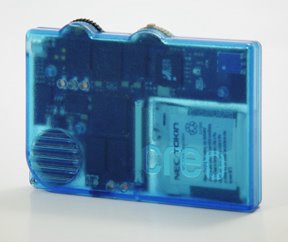
A small group of hardware and software engineers put together a prototype of a new kind of pda - one that completely used voice, with no stylus, and no display. What we found about people's use of PDAs was surprising, and showed a market gap still waiting for a commercial solution.
A wireless, voice-controlled pda. Crazy? or Visionary?
When we began the metabadge project and started to show the prototype, a frequent question was, "Why doesn't it have a display". The answer is simple - you don't need one.
This was 2002. Every pda, every existing version on the shelf had a screen. Yet our research showed people typically had one or two simple queries -
Where am I supposed to be right now?
Am I free Thursday at 2:00?
"Book an appointment, Friday at 10:00, Meet to discuss online help"
What is Dan's phone number?
metabadge enabled anyone who could speak or listen to answer these questions with as little as one button click. That's simplicity. That's ease of use.
The Creo metabadge - Top things people want from a PDA - without a display.
Top Issues Users had with PDAs
- Size - PDAs are too big to carry everywhere. If it's sitting on the desk, it's not personal enough.
- Sync - Care and feeding of a PDA was a leading reason to not use them after a few months. Simply too much bother to cable up and sync.
- Data Entry - Users ended up treating their PDA's read-only, since entering data was too cumbersome
- Complex - More features meant more clicks to do anything at all, even simple things.
metabadge Key Features
- small enough to fit in a pocket
- Airsync - Bluetooth® enabled, metabadge syncs automatically anytime it can or needs to
- Simple - one click tells you the time, and your next (or current!) appointment.
- Scroll - one scroll takes you through you future appointments or phone contacts
- Listen - voice synthesis plays your appointments and contacts so you can keep your eyes on the road
- Speak - uses Microsoft Speech Recognition, one phrase can book an appointment in Outlook
Creo's metabadge prototype was demonstrated publicly in 2002, but not commercialized. Yet.
Monday, October 03, 2005
Firmware - Quietly Running the World
Firmware is everywhere. If the joke about how your appliances will have IP address and chat to one another while you are at work is slightly worriesome to you, you should be very worried about firmware.
Firmware is not about underwear with wires and foam. Firmware is the netherworld between hardware and software that, like duct tape, just might be holding the world together. Except firmware isn’t as sticky.
Firmware is everywhere, burned into rom chips in cars, fridges, ovens, expensive toasters, house alarms, sprinkler systems (can you tell we are new house owners?), pda’s, audio equipment, cameras, watches, timers, and of course, computers.
Writing firmware is hard, and debugging it is even harder. Firmware runs in real-time, that is, it has to respond quickly to real-world events, like temperature sensors, switches opening and closing, as well as really slow events like waiting for someone to press a key (I imagine PC’s spend 99.9% of the time awaiting human interaction). Debugging firmware is hard because it runs in a resource-poor environment, where interaction with the hardware is the programmer’s main source of feedback. Since firmware is another form of software, we can expect it to be plagued with all the same problems we have come to expect from software.
A few years ago (pre-iPod) we bought a RioVolt cd/mp3-player. Not only did this cd-player play cd’s but it also played ISO-9660 disks of MP3 files. So this means we could compress 10 or so CDs onto a single CD-R and play about 10 hours off one disc. Cool.
No sooner did we get this puppy home than we checked out the web site, where I was informed there is an update to the firmware on this device? What could you possibly get wrong in v1.13 that you have to correct on 32KB of ROM? What else- new features. Better song sorting, easier ways to navigate the complexity of your disc and directories. Ok, fine. Now how do you actually go about updating the firmware of a CD/MP3 player? In this case, very cleverly. I expected some serial port/USB hack download utility. Forget it. You simply download the firmware upgrade file, then burn a CD with the upgrade firmware on it, and stick it in the player. It starts up, recognizes this upgrade file, and rewrites its own brains. I had to turn it back on by hand after. It now sports new features and a glowing v2.0 splash screen.
A year before, we had a rash of firmware upgrades for our laptops at the office, and it was a study in how hard and how easy a firmware upgrade can be. The guys using the NEC laptops had to upgrade from sloppy disc, a process that took two electrical engineers several hours to perform. On my Apple G3 powerbook, I downloaded the app off the web and ran it. It told me it would have to restart and the screen would show the upgrade process, then reboot. I clicked and watched. Sure enough, the application did something mysterious for a while, the machine restarted, and a very simple gui appeared showing the progress bar of the upgrade. Remember, firmware is right above the hardware layer so there is not a lot of operating system and graphics-card level resources for it to play with, so showing anything on screen came at the cost of someone poking pixels into video ram. After this 30 second upgrade was complete, the reboot took me back to the real world of operating systems, and one that could properly handle firewire again.
Upgrading firmware is always going to be a grungy task, since it is by definition low level. As systems get more complex, so does the firmware. I blew up our convection microwave oven by pressing keys in an order that I thought would convect but in fact nuked. A more disastrous case was the Therac-25, which left open a chance for a technician to perform a sequence of keystrokes that delivered 100 times the regular dose of x-rays to a patient.
As designers, we have to keep in mind the phrase I learned at a CHI (Computer Human Interface) conference years ago which was “Know Thy Users for they are not You.” Firmware will continue to be a critical component of a microprocessor powered world, and making it easy for mortals to deal with devices, as well as the ability to upgrade their firmware is another responsibility we should take seriously.
Now if you’ll excuse me, my refrigerator just e-mailed me complaining about the trashy language coming from the garburator…
Firmware is not about underwear with wires and foam. Firmware is the netherworld between hardware and software that, like duct tape, just might be holding the world together. Except firmware isn’t as sticky.
Firmware is everywhere, burned into rom chips in cars, fridges, ovens, expensive toasters, house alarms, sprinkler systems (can you tell we are new house owners?), pda’s, audio equipment, cameras, watches, timers, and of course, computers.
Writing firmware is hard, and debugging it is even harder. Firmware runs in real-time, that is, it has to respond quickly to real-world events, like temperature sensors, switches opening and closing, as well as really slow events like waiting for someone to press a key (I imagine PC’s spend 99.9% of the time awaiting human interaction). Debugging firmware is hard because it runs in a resource-poor environment, where interaction with the hardware is the programmer’s main source of feedback. Since firmware is another form of software, we can expect it to be plagued with all the same problems we have come to expect from software.
A few years ago (pre-iPod) we bought a RioVolt cd/mp3-player. Not only did this cd-player play cd’s but it also played ISO-9660 disks of MP3 files. So this means we could compress 10 or so CDs onto a single CD-R and play about 10 hours off one disc. Cool.
No sooner did we get this puppy home than we checked out the web site, where I was informed there is an update to the firmware on this device? What could you possibly get wrong in v1.13 that you have to correct on 32KB of ROM? What else- new features. Better song sorting, easier ways to navigate the complexity of your disc and directories. Ok, fine. Now how do you actually go about updating the firmware of a CD/MP3 player? In this case, very cleverly. I expected some serial port/USB hack download utility. Forget it. You simply download the firmware upgrade file, then burn a CD with the upgrade firmware on it, and stick it in the player. It starts up, recognizes this upgrade file, and rewrites its own brains. I had to turn it back on by hand after. It now sports new features and a glowing v2.0 splash screen.
A year before, we had a rash of firmware upgrades for our laptops at the office, and it was a study in how hard and how easy a firmware upgrade can be. The guys using the NEC laptops had to upgrade from sloppy disc, a process that took two electrical engineers several hours to perform. On my Apple G3 powerbook, I downloaded the app off the web and ran it. It told me it would have to restart and the screen would show the upgrade process, then reboot. I clicked and watched. Sure enough, the application did something mysterious for a while, the machine restarted, and a very simple gui appeared showing the progress bar of the upgrade. Remember, firmware is right above the hardware layer so there is not a lot of operating system and graphics-card level resources for it to play with, so showing anything on screen came at the cost of someone poking pixels into video ram. After this 30 second upgrade was complete, the reboot took me back to the real world of operating systems, and one that could properly handle firewire again.
Upgrading firmware is always going to be a grungy task, since it is by definition low level. As systems get more complex, so does the firmware. I blew up our convection microwave oven by pressing keys in an order that I thought would convect but in fact nuked. A more disastrous case was the Therac-25, which left open a chance for a technician to perform a sequence of keystrokes that delivered 100 times the regular dose of x-rays to a patient.
As designers, we have to keep in mind the phrase I learned at a CHI (Computer Human Interface) conference years ago which was “Know Thy Users for they are not You.” Firmware will continue to be a critical component of a microprocessor powered world, and making it easy for mortals to deal with devices, as well as the ability to upgrade their firmware is another responsibility we should take seriously.
Now if you’ll excuse me, my refrigerator just e-mailed me complaining about the trashy language coming from the garburator…
Sunday, September 18, 2005
CBC and being Canadian
The dispute between mother corp. and the Canadian Media Guild seems to be lasting longer than I had hoped or expected. Perhaps it is, as one guild member suggested to me, that CBC management won't feel any urgency to settle until hockey season starts and they can't snap up that big commercial revenue that supplements the fed money that keeps cbc going.
My sympathies weigh in with the on-air talent, but I have to admit that it makes some sense that the corp. needs to be able to change programming to keep up with trends and competition. You can read the blogs and make up your mind.
One effect of the dispute is that cbc is playing "best of" shows from as far back as 2003, I guess trying to keep many of us from permanently drifting off to commercial radio as a lifestyle choice. It'll work for a while, at least for me, and at least for as long as the level of conversational tone on Vancouver rock stations remains at high school level. But there have been a couple recent events that together have really made me reflect on what it is to be Canadian.
It's lame to fall back on defining ourselves by our differences from the Americans. What are our distinctive Canadian values and society? The two glimpses I saw this week: 50 tracks replays on CBC, and the 25th anniversary of Terry Fox's Marathon of Hope. Fifty Tracks is being repeated in thr 5-6pm drive time, not a bad choice. In this slot various media and music people nominated the most significant songs of a decade. Then the audience weighs in. Typical of the critics, they select the seminal bands and tunes that defined a musical genre, and the rest of us just pick the ones from the top 40 that bring a smile of recognition and remembrance. The insight that it offers as a gestalt of Canada is this - what kinds of Canadian artists and songs are our contributions - Gordon Lightfoot, Joni Mitchell, The Guess Who, Neil Young, Stan Rogers, The Tragically Hip, April Wine. Our artists play it straight - straight from the heart, and straight speaking. We're generally a country of plain speakers, who love our stories, and respect the storytellers without making them pedestal-tippy icons, or reveling in their human foibles.
Which takes me to Terry Fox. This year 10,000 schools across Canada ran various races to raise money for cancer research. It has been 25 years since Terry Fox started on his cross-Canada trip, trying to raise $1 for every person in Canada, which at the time was around 25 million. Since that time over $360 million has been raised worldwide in his name.
Terry was a hero in the core sense of Canada. He set out to do something hard, he endured pain that many of us would not choose to endure, and he took each day one step at a time, each run one step at a time. He didn't aspire to greatness, he just wanted to do something significant on as large a scale as he could with whatever time he had.
As should we all.
My sympathies weigh in with the on-air talent, but I have to admit that it makes some sense that the corp. needs to be able to change programming to keep up with trends and competition. You can read the blogs and make up your mind.
One effect of the dispute is that cbc is playing "best of" shows from as far back as 2003, I guess trying to keep many of us from permanently drifting off to commercial radio as a lifestyle choice. It'll work for a while, at least for me, and at least for as long as the level of conversational tone on Vancouver rock stations remains at high school level. But there have been a couple recent events that together have really made me reflect on what it is to be Canadian.
It's lame to fall back on defining ourselves by our differences from the Americans. What are our distinctive Canadian values and society? The two glimpses I saw this week: 50 tracks replays on CBC, and the 25th anniversary of Terry Fox's Marathon of Hope. Fifty Tracks is being repeated in thr 5-6pm drive time, not a bad choice. In this slot various media and music people nominated the most significant songs of a decade. Then the audience weighs in. Typical of the critics, they select the seminal bands and tunes that defined a musical genre, and the rest of us just pick the ones from the top 40 that bring a smile of recognition and remembrance. The insight that it offers as a gestalt of Canada is this - what kinds of Canadian artists and songs are our contributions - Gordon Lightfoot, Joni Mitchell, The Guess Who, Neil Young, Stan Rogers, The Tragically Hip, April Wine. Our artists play it straight - straight from the heart, and straight speaking. We're generally a country of plain speakers, who love our stories, and respect the storytellers without making them pedestal-tippy icons, or reveling in their human foibles.
Which takes me to Terry Fox. This year 10,000 schools across Canada ran various races to raise money for cancer research. It has been 25 years since Terry Fox started on his cross-Canada trip, trying to raise $1 for every person in Canada, which at the time was around 25 million. Since that time over $360 million has been raised worldwide in his name.
Terry was a hero in the core sense of Canada. He set out to do something hard, he endured pain that many of us would not choose to endure, and he took each day one step at a time, each run one step at a time. He didn't aspire to greatness, he just wanted to do something significant on as large a scale as he could with whatever time he had.
As should we all.
Friday, September 09, 2005
Cars are amazingly heavy...
In both senses of the word. I had the chance last summer to see and hear Dean Kamen talking about - what else - the Segway Human Transporter. While I haven't bought into the Segway vision, or for that matter, an actual Segway, Dean pointed out some facts about cars, especially SUVs that once you hear them, makes it hard to think of them the same when you see them on the street. Dean compared the weight of a person, say 150lbs, with an SUV, of about 6,000 pounds. Hopping into the SUV to drive to the store to get a liter of milk is like Cleopatra getting carried in her sedan chair by 40 slaves. Disturbing analogy. Try this one - try to push your car, especially up a gentle incline. Because car engines are so powerful, we lose the sense of how much power it takes to climb hills, and turn corners. We just push a little pedal, and a stream of liquified dinosaurs burns up and drags this huge hunk of steel and plastic around.
So, I'm starting to ride my bike to the store for milk. My wife has some foolish argument this is a better use of heart, lungs, and money than buying a Segway HT (with yellow fenders). Dang.
So, I'm starting to ride my bike to the store for milk. My wife has some foolish argument this is a better use of heart, lungs, and money than buying a Segway HT (with yellow fenders). Dang.
Wednesday, August 10, 2005
Film Directing and Product Management
I have two lives. Now, before you run off to tell my wife, calm down. But really, I have two lives. One of these lives is described on the left side of the piece of paper that is my resume. The other life is on the right side. One of these lives has a future, the other does not. The question is - which one?
The left side is engineering centric. I knew when I was about 12 years old that I wanted to be an electrical engineer, and that aspiration has been achieved. Several years of software design, hardware hacking, working on a Lisa and Mac, worked on a new kind of pda. Most fun has been being a product manager - bringing a product from fuzzy notion to shipping product, and an experience I've had the privelege to repeat with Creo's Virtual Proofing Software, Prinergy, and metabadge. What makes Product Management so attractive to me is that it is applied storytelling.
The right side is full of small, amazingly fun things that have to do with music, video and film. I've done live mixing for bands, and recorded basement tapes of a few. I've shot super 8, and gotten high on the splicing cement. I've been a boom man for college projects, and shot a few videos to learn about non-linear editting. After taking the Director's course at the Vancouver Film School, I came to this conclusion:
Directing film/video is very much like product management. Maybe that's why I like the both. Look at the similarities. 1) You are the leader of a team, of various skills and abilities, who you need to work together to achieve a common purpose. 2) While technical potentials tempt you at every turn, it is your job to stay focussed on the story. 3) Your team works better if you collaborate rather than rule, but sometimes the team looks to you to just make a decision. 4) You are telling a story, and the integrity of that vision is the primary reason behind all the tech.
So, there it is. I'm ready to direct. Where to start?
The left side is engineering centric. I knew when I was about 12 years old that I wanted to be an electrical engineer, and that aspiration has been achieved. Several years of software design, hardware hacking, working on a Lisa and Mac, worked on a new kind of pda. Most fun has been being a product manager - bringing a product from fuzzy notion to shipping product, and an experience I've had the privelege to repeat with Creo's Virtual Proofing Software, Prinergy, and metabadge. What makes Product Management so attractive to me is that it is applied storytelling.
The right side is full of small, amazingly fun things that have to do with music, video and film. I've done live mixing for bands, and recorded basement tapes of a few. I've shot super 8, and gotten high on the splicing cement. I've been a boom man for college projects, and shot a few videos to learn about non-linear editting. After taking the Director's course at the Vancouver Film School, I came to this conclusion:
Directing film/video is very much like product management. Maybe that's why I like the both. Look at the similarities. 1) You are the leader of a team, of various skills and abilities, who you need to work together to achieve a common purpose. 2) While technical potentials tempt you at every turn, it is your job to stay focussed on the story. 3) Your team works better if you collaborate rather than rule, but sometimes the team looks to you to just make a decision. 4) You are telling a story, and the integrity of that vision is the primary reason behind all the tech.
So, there it is. I'm ready to direct. Where to start?
Friday, August 05, 2005
Time to Start
The ship is sailing, but I've hopped into the trusty kayak and paddled out to jump on.

Subscribe to:
Posts (Atom)